In which an atheist responds to the American debt crisis by reading the Bible

I am an atheist but I was brought up among people of deep and convincing faith. By \”convincing faith\” I do not mean that they were convinced of their own faith but that I was convinced that they truly believed. I was convinced of their faith because they lived that faith every day of their lives.

I learned the 23rd Psalm by heart sitting on my grandmother\’s knee. I learned not that we should go to church on Sunday but that we were enjoined not to make others work on Sunday:

But the seventh day is the sabbath of the LORD thy God: in it thou shalt not do any work, thou, nor thy son, nor thy daughter, thy manservant, nor thy maidservant, nor thy cattle, nor thy stranger that is within thy gates (Exodus 20:10)[1]

My mother liked to remind people that one of the greatest statements of love and devotion in the Bible was made by one woman to another:

And Ruth said, Intreat me not to leave thee, or to return from following after thee: for whither thou goest, I will go; and where thou lodgest, I will lodge: thy people shall be my people, and thy God my God: Where thou diest, will I die, and there will I be buried: the LORD do so to me, and more also, if ought but death part thee and me. (Ruth 1:16-17)[1]

My mother is dead but I still have the Bible that she was given when she was a child. Her favourite passages are marked and as I reread them I imagine her marching into Congress and standing on the floor of the House declaiming them:

Thou shalt not oppress an hired servant that is poor and needy, whether he be of thy brethren, or of thy strangers that are in thy land within thy gates: At his day thou shalt give him his hire, neither shall the sun go down upon it; for he is poor, and setteth his heart upon it: lest he cry against thee unto the LORD, and it be sin unto thee. (Exodus 24: 14-15)[1]

*********

Thou shalt not pervert the judgment of the stranger, nor of the fatherless; nor take a widow\’s raiment to pledge:
But thou shalt remember that thou wast a bondman in Egypt, and the LORD thy God redeemed thee thence: therefore I command thee to do this thing.
When thou cuttest down thine harvest in thy field, and hast forgot a sheaf in the field, thou shalt not go again to fetch it: it shall be for the stranger, for the fatherless, and for the widow: that the LORD thy God may bless thee in all the work of thine hands.
When thou beatest thine olive tree, thou shalt not go over the boughs again: it shall be for the stranger, for the fatherless, and for the widow. When thou gatherest the grapes of thy vineyard, thou shalt not glean it afterward: it shall be for the stranger, for the fatherless, and for the widow. And thou shalt remember that thou wast a bondman in the land of Egypt: therefore I command thee to do this thing.(Exodus 24:17-22)[1]

*********

Then shall the King say unto them on his right hand, Come, ye blessed of my Father, inherit the kingdom prepared for you from the foundation of the world:
For I was an hungred, and ye gave me meat: I was thirsty, and ye gave me drink: I was a stranger, and ye took me in:
Naked, and ye clothed me:
I was sick, and ye visited me:
I was in prison, and ye came unto me.
Then shall the righteous answer him, saying, Lord, when saw we thee an hungred, and fed thee? or thirsty, and gave thee drink?
When saw we thee a stranger, and took thee in? or naked, and clothed thee?
Or when saw we thee sick, or in prison, and came unto thee?
And the King shall answer and say unto them, Verily I say unto you, Inasmuch as ye have done it unto one of the least of these my brethren, ye have done it unto me.
Then shall he say also unto them on the left hand, Depart from me, ye cursed, into everlasting fire, prepared for the devil and his angels:
For I was an hungred, and ye gave me no meat:
I was thirsty, and ye gave me no drink:
I was a stranger, and ye took me not in: naked, and ye clothed me not: sick, and in prison, and ye visited me not,
Then shall they also answer him, saying, Lord, when saw we thee an hungred, or athirst, or a stranger, or naked, or sick, or in prison, and did not minister unto thee?
Then shall he answer them, saying, Verily I say unto you, Inasmuch as ye did it not to one of the least of these, ye did it not to me. And these shall go away into everlasting punishment:
but the righteous into life eternal. (Matthew 25: 34-46)[1]

I don\’t know what book the politicians in Washington are referring to when they speak about The Bible but I do know that it isn\’t the one my mother read and cherished. I know it isn\’t the one my father reads from every day. I know it isn\’t the one my great-aunt preached from. I know it isn\’t the one my uncle wrote sermons about. I know it isn\’t the one my grandmother loved.

My mother\’s greatest statement of condemnation for anyone was I wouldn\’t give him a cup of tea if he was thirsty. It was a threat that I never saw her carry out. She fed people whose politics she abhorred and she often made the bread that she broke with people who many of those politicians would call sinners.

If my mother was alive right now I think she might not be willing to give a cup of tea to the politicians in Washington who are threatening to take away the widow\’s mite and denying the poor the right to glean the once-harvested fields.

[1] All quotations are from my mother\’s copy of the King James Version of The Holy Bible.

Book Review: Paying Guests

Paying Guests by E. F. Benson (1929)

Those who are familiar with E. F. Benson only through his Lucia and Mapp books may initially find this book disappointing since it is set in a different location both geographically and socially. None of the characters rise to the magnificence of Emmeline Lucas or Miss Mapp and the social circle of the residents of Wentworth is neither as wealthy as that in Riseholme nor as settled in its hierarchical patterns as that of Tilling. This reviewer encourages the reader (whether familiar with Benson or not) to read on. Paying Guests is a wonderful examination of a particular subsection of the English gentry that would be squeezed out of existence by the falling returns on dividends, the dismantling of the British Empire and the next World War. It is also a magnificent picture of the gender dynamics in England between the two World Wars. Finally it is a wonderful exploration of a recurrent theme in Benson in the last half of his writing life–the problem of how one fills up the minutes and hours of one’s life if one has no real interests, no real passions and no real work.

Beyond here there be spoilers…….

On the surface Paying Guests is a series of scenes and incidents from the lives of the owners and lodgers of Wentworth boarding house at Bolton Spa. It is also about the ways in which people “of a certain class\” fill their time and elude boredom. Many of the lodgers at Wentworth have come to take the waters in hopes of relieving, if not curing, their bodily ills but that is not the case for all the guests. In fact the two, Miss Howard and Colonel Chase, around whom most of the regular life of the house revolves, are quite healthy.

Colonel Chase is known at Wentworth for what he clearly considers to be prodigiously long bicycle rides and country walks. These activities play an important part in the Colonel passing the hours of the day. He rises, has tea and toast in bed, comes down to breakfast, reads the morning papers, rides his bike, lunches, goes for walk, has tea and plays bridge. He does not make the meals he eats any more than he makes the bed in which he sleeps every night. Colonel Chase spends his time in activities that allow him to avoid empty moments but he contributes nothing to the comfort and ease in which he lives. The (widowed) Mrs. Oxney and her sister (and fellow widow) Mrs. Bertram, hire the staff and do some of the practical work around the house themselves. Colonel Chase spends his time spending his time. He does not work at an income generating job and the reader may wonder if even the things with which he passes his time are enjoyable in and of themselves. He does the crossword puzzle but it seems that he gets more joy out of defeating others at Wentworth in the time it takes to complete it than he does in the actual completion. His extreme anger at losing his walking pedometer and in the failure of his bicycling pedometer suggests that much of the enjoyment he derives from walking and cycling lies in telling others about his records. He enjoys playing bridge but apparently enjoys the chance to instruct and correct those around him more than actually playing the game.

The two things that Colonel Chase does seem to enjoy wholeheartedly are having his comfort and having others arrange for that comfort. Thus his mind turns to the idea of marriage not because of love, monetary need or the desire for companionship but because he hoped for, in the case of one possible Mrs. Chase, an increase in his wealth and prestige and in the case of the other the guaranteed continuation of the comfort and ease to which he had become accustomed.

Miss Howard, unlike Colonel Chase, cannot look forward to a life that would always assure that her physical wants and emotional needs would be the central concern of the people with whom she lived. As the book opens Miss Howard had managed to hold on to her internal girlhood:

She had been an extremely pretty girl, lively and intelligent and facile, but by some backhanded stroke of fate she had never married, and now at the age of forty, though she had parted with her youth, she had relinquished no atom of her girlishness. She hardly ever walked, but tripped, she warbled little snatches of song when she thought that anyone might be within hearing in order to refresh them with her maidenly brightness, and sat on the hearth-rug in front of the fire, even though there was a far more comfortable seat ready. It was not that she felt any profound passion for tripping, warbling and squatting, but from constantly telling herself that she was barely out of her teens she had got to believe in her girlishness and behaved accordingly.(21)[1]

It is questionable how much longer Miss Howard could continue to be treated like a young woman and how soon she would pass into the sad world of the spinster–the woman who had failed to land herself a husband and the consequent gravitas accorded to the married woman.

Paying Guests is also the story of a very ordinary young woman who, like Miss Howard, was financially secure and unlike Miss Howard seemed never likely to marry. Miss Kemp’s role in life up until the point the reader meets her, was to listen to her father’s stories, to fetch and carry for him and to center every moment of her life around the man’s arthritic and rheumatic aches and pains. Mr. Kemp does not appreciate his daughter efforts to please him. In fact Mr. Kemp does not seem to appreciate anyone’s efforts to make his life comfortable. He has given over the last years of his life to ministering to his every ache, twinge, need and want. He resents that his late wife left half of her fortune to their daughter leaving him only with a life-time interest in the other half of the estate. Up until the the books open the Mrs. Kemps bequest has made no material difference in his life since Miss Kemp has not lived in the London flat left to her by her mother but instead devoted all her time and money to the care of her entirely unappreciative father.

Benson doesn’t take the easy route of presenting the reader with characters who have found themselves in dire and tragic circumstances. Miss Howard is somewhat self-deluding and has found herself trapped by small exaggerations and misleading statements that have led others to presume that she is wealthier and with more aristocratic connections that was the case. Miss Kemp is trapped in a life of boredom and stagnation by filial pressures. Neither is facing ruination although both are facing a long emotionally starved life. Colonel Chase is faced with the problem of insuring that he can live out the rest of his life in the self-centered ease to which he has become accustomed. Mr. Kemp worries that his physical and emotional concerns will always be catered to.

The open chapters of Paying Guests hint that some change is about to happen among these residents of Wentworth and that is indeed what will happen. This is, in its own way, a love story. That the love in question is between two adult women is of no consequence at all to the story, save for the fact that as women past the age of marriage (past their twenties) neither had much hope for any form of marriage except to an older man who was looking for passable looking women with some capital who would look after his house and create a buffer between him and a world that did not cater to his every whim. It is only with another woman that a life of service to a husband, father or other father member could be avoided.

By the end of the book all of the major characters have moved closer to their physical and emotional goals. The route this took may have surprised them just as modern reader may be surprised by the ease and skill with which Benson wrote about what we now tend to think would have been a taboo subject.

In short–a book to read, to reread and to place on the shelf next to the rest of Benson’s best.

Rating: 4-1/2 stars

Benson, E. F. Paying guests. London: Hogarth Press, 1984.

Would it have been less of a tragedy had she not been beautiful?

While I am not a particular fan of magazines, networks and TV shows that focus almost obsessively on \”true life\” crime I am aware of the major stories that saturate their pages and time. Indeed, for someone who researches popular culture it would have been difficult in the last few weeks not to be aware that Casey Anthony was on trial (in Orlando, Florida) for the murder of her daughter Caylee. And it would have been, if anything, even more difficult to remain ignorant of the outcome of that trial and the angry public response to that verdict.

At another time I may address both the verdict and the responses. Here and now I want to write about the framing of tragedy itself. In comment after comment on television, in article after article in newspapers and magazines and in post after post on the internet we are told (and reminded) that Caylee Anthony was a beautiful child. For example:


the tragedy surrounding the loss of this beautiful little girl cuts to the heart of everyone
[The Casey Anthony case and abortion: a tragic disconnect]

The alleged murderer of Caylee Marie, a beautiful little girl.[Casey Anthony Jury Selecton Under the Big Top]

From the start, her mother Casey willfully lied to the police about what happened to the beautiful little girl [Why Is Casey Anthony Smiling In Court]

I have never had any doubt that Casey killed her daughter. Her beautiful little girl with the big brown eyes.[Casey Anthony could take a lesson from Charlene Spierer]

a beautiful little girl\’s life was cut oh so short, and there\’s no doubt in my mind who did it.[Caylee Anthony: A beautiful life cut short]

This emphasis on the beauty of the victim is not unique to the Anthony Case. For example, consider the case of Natalee Holloway of whom one can read:

How did this beautiful, sweet girl end up murdered?…..[comment to the post Natalee Holloway: Jaw Bone Found in Aruba, Sent for tests at the NFI Forensic Institute in The Hague.

Dave and Jug, both busily trolling the Internet in their search for donated funds to enable on-island search efforts to resume, surely can have no excuse for their continued absence from Aruba, where Natalee Holloway, the beautiful missing-from-Aruba Alabama honours student, disappeared in the last days of May. [Natalee Holloway Is Missing From The Missing Persons Lists]

Or JonBenet Ramsey:

JonBenet Ramsey. The beautiful little girl who wowed crowds at beauty pageants [New DNA Clue Found in JonBenet Ramsey Murder Case]

A beautiful little girl with a dazzling smile lives a wonderful life with her family in their Colorado mansion.[The Truth About JonBenet Ramsey]

Or Elizabeth Smart:

Before June 5th of last year, the Smarts led the kind of life most people would consider blessed: a happy marriage and six beautiful children.[Elizabeth\’s Road Home]

Ed Smart and his beautiful daughter, Elizabeth[Transpcript: NANCY GRACE
Interview With Elizabeth Smart, Aired July 18, 2006 – 20:00:00 ET
]

Reading the typical newspaper coverage of crime, listening to the news and watching news magazines one wonders–do they only cover the abductions and/or murder of females who could be described as beautiful or or does the description \”beautiful\” simply mean \”a life that we value\”? Has beauty become synonymous to \”worthy to live?\” Do we only empathize with the parents who have lost a beautiful child? Do we only sympathize with the husband who has lost of beautiful wife? Are females who are not beautiful invisible? Are children who are not beautiful disposable?

The reader might argue that \”obviously\” I am exaggerating. They might argue that even the worst of the worst don\’t pick which child or woman to value on the basis of their beauty but ask yourself this question–why is it so important for writer and speaker to tell their audience over and over again that the victim of choice is beautiful?

The reader might also meditate on the glaring and painful disparity between the demographics of the country (and the demographics of the missing and murdered) and the demographics of those who are described as \”beautiful.\”

Book Review: Wild Strawberries

 
Wild Strawberries by Angela Thirkell (1934)

The events of the book occur over a period of several summer months, centered chiefly iat Rushwater House, the rural home/estate of the Leslie family. Over that period of time the grandson of Lady Emily and Mr. Leslie turns seventeen and some gentle pairing off occurs of eligible members of their social circle. The plot, such as it is, unfolds with the greatest of gentleness such that it feels, at the end, that the reader spent a very agreeable weekend with the family and watched as their life unfolded.

past here, there be many many spoilers

Wild Strawberries belongs firmly to a time past. Set in the English countryside of (the fictional) Barsetshire, the book is separated from the modern (and especially the non-English modern) reader by what feels like like a much more than a century’s chasm of time. Yes, many of the differences between the world of the books and that of the present-day reader can be set down to the effect of technological change and another war that spanned the globe, but what makes the book read slightly more like science fiction (or an alternate reality) are the cultural/social differences between the world in which Thirkell wrote and the world inhabited by the present day reader.

Take, for example, the treatment (by the narrator of the book and the individuals who people the book) of Lady Emily Leslie. As the book opens the Vicar is anxiously waiting for Lady Emily to arrive before the (public) church service could begin. The Vicar, who finds her constant lack of punctuality stressful, also considers her to be universally loved although universally irritating. Lady Emily does not limit her lack of consideration for others to her chronically and disruptively lateness that interrupts the church service for everyone, she also makes it a point to instruct others where to sit, to insist of “helping\” others who have asked for no help and need none, and at her daughter’s wedding she went so far as to “attempt[ing] to rearrange the order of the bridesmaids during the actual ceremony.” The Vicar, we are told, prayed that he would never criticize Lady Emily again after seeing the pain on her face after her woman’s son was killed in the Great War.

At this point my class sensibility rises up and I cry foul. Yes, Lady Emily’s eldest son died in the field somewhere on the continent. But, I would venture, it was unlikely that there were many families in that parish who had not lost a loved one in the Great War. Does one imagine for a moment that the Vicar would have been so understanding (and so hard on himself for resenting her behaviour) if the woman who was routinely disrupting every church service had been an housemaid, a washerwoman or the wife of workingman? We may be told that Lady Emily was loved by all but what we see is Lady Emily displaying the monstrous self-centeredness of a member of her class. Thirkell describes Lady Emily as “behaving altogether as if church was a friend’s house\” and indeed she does act in church just as she does in her own house, and the houses of her friends, expecting others to defer, to be patient, to serve and to privilege her wants above even (or perhaps especially) their own.

It is a theme that ran through much of English writing at the time this book was published, that thoughtless, indeed criminal, behaviour was eccentric and charming if it was carried out by a member of the upper class. And indeed it is clear, if one reads closely, that members of Lady Emily’s household are quite aware of the fact that she is disturbing the lives the those around her, that she was causing extra work and much concern for many of their retainers and that, in end, Lady Emily got what made her happy rather than what would really make those around her contented. [Note: The person who disrupts your life in order to make you sit in the chair zie would sit in if zie was you is not considerate and thoughtful–they do what they do in order to present themselves to the world as being thoughtful without having ever to go to the actual effort of considering the wishes of others.]

The world of Thirkell’s characters is one with class assumptions/presumptions so thick on the ground that individual instances melt into one another. Lady Emily’s grandson will inherit the estate on the death of her husband, and since we are told that “[i]nheritance and death duties were not words that trouble Martin much” the estate is rich enough that there will both both and yet that information is imparted as if having sufficient assets that taxes must be paid were a special burden that the family must bear with great difficulties. Of one of Lady Emily’s surviving sons we are told, “If he had had to earn his living, David would have been a serious problem. But, owing to the ill-judged partiality of an aunt, he had been independent for some years.\” In other words this is a world in which there is often a family member who is well off enough that they can leave substantial amounts of money to relatives.

The unfairness of this is obvious in a further description of David’s life, “and every now and then his looks and his easy manners and his independent income landed him a job, though not for long.\” Those “easy manners\” [manners that were viewed as appropriate and acceptable to other members of the social circle to which David was born] were at least in part the result of being first raised by nannies and then being sent off to an expensive school and the independent income was a result of being a member of the class in which is was not uncommon to have wealthy relatives. These initial advantages result in him having a continued marked advantage over the many unemployed who actually needed a job.

The fact that, at the time this book was written, unemployment was a serious problem in England is only touched on tangentially and then only by attacking some of those who worked for taking the jobs from others who wanted to work. One often finds characters quite openly speaking out against the idea of woman working– although this is quite clearly about women of their class working since the book is full of nannies and cooks and housekeepers who are all women and most definitely work:

Having paid this lip service to the hateful Miss Stevenson, she felt she had gone far towards appeasing her conscience in the matter of her bad behaviour at lunch.

‘Don’t know what they want all these girls for,’ said Mr. Leslie. ‘Taking jobs from the men. Glad you don’t want to have a job, Mary.’

“I am afraid I did have a job for a bit,’ said Mary, ‘ in a library.’

‘Oh, books, that’s all right. No harm in a girl reading a bit. It’s all this education I object to. Same everywhere. All these young young people going to the university and coming away half-baked. Can’t even talk English.’[1] (385)

Even within Thirkell’s world of established country families (daughters of dukes and earls married to untitled gentlemen who have country homes, who have with daughters who take tea at Buckingham Palace and whose sons engage in businesses just to keep themselves occupied rather than to put food on the table) there are great variations in wealth. Mr. Holt lives on declining dividends while managing to live in the style he wished to be accustomed by “being a toady” and is portrayed cuttingly by Thirkell and mocked by the Leslies. Mary Preston is shown in a much more friendly light:

‘Let’s sit down and bask,’ said David. ‘I can’t feel happy till I get
the sun in my bones, can you? Would one do without the Riviera?’

‘Do without it, I suppose,’ said Mary….’I’ve never been there, but I’m still alive.’

‘Never been to the Riviera,?’ said David, looking at her with interest.
……..

[Mary] realized that to him an existence which did not imply at least a couple of thousand pounds a year of one’s own was fantastic. She was tempted to say, ‘I have two hundred a year of my own and mummie has about six with her pension for daddy, and we pig along somehow,’ but felt this would be unladylike.[1](348)

While the impact of social/cultural changes sometimes subtly underlines (or undermines) the reader’s appreciation of the book there other moments which resonate chillingly over time as in the following case: Two characters have gone to a train station to pick up a visitor…

The crowded bank-holiday train had only just pulled in…In any other place the sight of two stalwart young men advancing with a gliding step, arms liked like skaters, uttering what they fondly hoped was a college yell, might have attracted attention, but the hikers, many of whom had already struck up folk-songs of whose doubtful meaning they were luckily unaware, took David and Martin for some of themselves. A few gave the Fascist salute, to which David politely made reply, ‘Good morrow, good my lieges,’ while Martin more simply responded ‘Ave.’ [1](339)

The stereotyping of “foreigners\” is not only unrelenting it is accepted with amusement in that social circle. No group or country really escapes the mockery although it is clear that it is slightly less offensive to be from north Europe than from other places in the world. Anyone who falls outside of that zone of “almost English” is referred to in terms which the modern reader may find breathtakingly offensive:

John gave his mother her barley water. David helped himself to whisky and soda and drifted over to the piano, where he played and sang snatches of music from revues and musical comedies with such masterful ease that Mary was more than ever glad the men had not been in the room when she was singing.

‘You must have had a black mammy for your fairy godmother, David,’ said John. ‘I don’t see how else you got that nigger ouch in your voice.’[1](366)

The Nazis are mentioned in passing but one would be hard pressed to deduce from reading Thirkell (or many other authors of the time) that various European countries has been, since the end of the Great War, suffering from massive unemployment and occasional hyper-inflation. The closest any the characters come to these fiscal realities is a concern about declining dividends. Jews were not, at that time, part of the social life of the gentry/aristocracy of England and it will not be until several years later when Jewish refugees start to arrive in larger numbers that the subject of what is happening in Germany will even surface in most of contemporary English fiction.

While the author has not attempted to limn a portrait of English political life in the mid-thirties she does do a wonderful job at drawing a picture of how “ordinary\” life was lived among the class on which is she is focusing. Whether Thirkell intends the reader to notice, indeed whether Thirkell herself notices, the gentry around whom this story revolves are bullies. They may be solicitous of “their own” but they are openly proud of their right and ability to bully. This can be seen in almost all their actions from Lady Emily and her family taking as their right the power to disrupt community church services, to the joint and open baiting of Mr. Holt whose only sin is to be a toady whose time has passed to the casual reference to the fact that as a child David Leslie made a habit of harassing the kitchen cat.

The Leslies, their friends and those in their social circle live in a world distanced from the what were, for most, the realities of life. Mr. Leslie raises and sells bulls but does not seem to do so for reasons of profit as much as he does because it is an interesting hobby. John Leslie has a business, indeed Mary Preston visits him there, and yet there is nary a hint as to what type of business is conducted at his office although one does learn details about when tea is served and with what type of biscuit. Mary and her mother struggle to get by on a sum that would have seemed a fortune to the maids who unpacked her suitcases when she arrived at Rushwater House. Much of what the characters do is not work so much as it is “make work” and often what is defined as work (for example, picking the flowers for the house) turns out to be the haphazard supervision of servants who actually cut the flowers, arrange them and place them around the house.

Just as there is always a servant to do the actual work there is always a plenitude of space. Agnes (the married Leslie daughter) has no job and only three children and yet she has not only a nannie (referred to only as “Nannie”) but also “a girl” (Ivy) who helps her. The children have bedrooms and also a nursery which appears to be a large room given over to the children and their needs. You get a sense of this when Agnes tells John why she and her family couldn’t manage in the house he is thinking of selling:

I wish I could take it myself, only there wouldn’t be room for the children. We really need so many rooms now. A day nursery and a night nursery, and a room for James, and a room for Ivy. And when Emmy is a little bigger she will want a room for herself. And when I have some more babies it will mean another nursery as well.

John laughed and asked if Agnes didn’t find her household difficult.

‘Oh, no,’ said she in surprise,’ it is quite easy. And when I have some more babies I shall get a second nurse as well as Ivy. It is really no trouble.’[1](413)

The one thing that the Leslies seemed to be short of is private time in which individuals could actually get intellectual and physical work done. No wonder women dreamed of having “a room of their own” when most of their lives were taken up in looking after others even to the point of staving off their boredom. While one set of women cleaned up the remains of the dinner another set of women played the piano, sang and read aloud. Only women who, like Lady Emily or Lady Dorothy, were renowned for their selfishness, did not mold their lives around the needs and desires of the greater family.

By the end of the book this reader felt a strange affection for two fairly minor characters–Lady Dorothy Bingham and Miss Joan Stevenson–both of whom were judged harshly by others (a domineering widow and a “hard” university woman with a job) and both of whom had a tendency to carefully survey their environment and clearly asses the situation:

‘I think Lionel Harvest is a nephew of yours,’ said Miss Stevenson. ‘He us under me at Broadcasting House.’

“Is he? Queer boy, Lionel. I’d let my girls go out with him, but I do’t know that I’d let my boys.’ Here Lady Dorothy laughed the laugh before which every fox in her division of the country quailed. ‘He’ll come into four thousand a year though when old General Harvest dies.’

Miss Stevenson registered this statement with her well-trained brain. [1](450)

Lady Bingham deploys her money and influence without asking that others pretend that she is doing them a favour and Miss Stevenson has realistically decided that the best thing insurance for a university educated woman is to find a well-off husband who will be happy with what Miss Stevenson so diplomatically refers to as a “companionate marriage.\”

The Second World War looms, not yet on the horizon but not that far away. This reader thinks that Lady Dorothy and Miss Stevenson are better prepared to navigate the upheavals to come than are the Leslie family.

Rating: 3-1/2 stars
[1]Thirkell, Angela, 1966 An Angela Thirkell omnibus / with an introduction by Elizabeth Bowen Hamish Hamilton, London,

He\'s fat is not a reasoned political argument

One of the prejudices that figures on both the left and right of American politics seem to feel quite free to express quite openly is to be \”anti-fat.\” Just as pundits on the right fling the \”fat\” epithet at Michael Moore and Al Gore pundits on the left throw around the same insults. For example Wonkette\’s entire argument against Chris Christie appears to be \”don\’t listen to him, he\’s fat.\” 


Chris Christie Makes Fox News Tilt Left


Remind me again why it is wrong for \”the right\” to do this but not the left. Remind me again why it is wrong to discount someone\’s opinions on the basis of the colour of their skin but not on the basis of how much they weigh.

Before the Fact by Francis Iles (1992 )


SPOILERS ABOUND

If Before the Fact is remembered other than by enthusiasts of the “alternate” murder mysteries that were relatively popular in England in the 1930s it is as the inspiration of Hitchcock’s Suspicion.

BTF was published in 1932 and for the reader who knows only the England of Marsh, Allingham and Christie it may come as a shock to find a story which deals so openly, if with a somewhat oblique form of openness, with matters of sexuality. The POV character, Lina, is clearly frigid during the first weeks of her marriage before finding pleasure in sex. Her husband, Johnnie, describes her then as having been like a wet fish in bed. We learn that, if Lina had allowed, Johnnie would have experimented unspecified sexual ‘abnormalities.’ Lina, during a time when she is estranged from her husband, frankly considers the possibility of not just taking a lover but of living openly with him.

The ‘twist’ of the book is that the ‘murderee’ as she comes to think of herself, is aware ‘ Before the Fact’ that her husband intends to murder her. Indeed she knowingly takes the poisoned drink from her husband only after she is sure that he will ‘get away’ with murdering her.

My lack of patience with the book is that after one gets over its novelty one realizes that it is a comparatively well written exercise in making the victim to complicit in her victimization that one ceases to blame her victimizer for his actions. Indeed one finishes the book blaming neither the murderer or the person who stood by watching his actions. The Lina whose mind the reader sees into is suffering from masochism so great that she talks herself into seeing her husband, a man of ruthless egotism who has robbed and murdered his way through life, as a child for whom she is responsible. How many women who end up in battered women’s shelters have bought into this idea that somehow it is their fault that they were not able to reign in the weaknesses of the man in their lives? Though Iles works hard to make Johnnie an attractive cad to this reader he is merely a man who preyed on other people. The author may have written the book to explore why people stay in such oppressive relationships but on rereading it seems more like a paean to wifely martyrdom. Rather than seeing Lina as a martyr or a woman who loved not wisely but too well this reader saw her as a woman who had as weak a moral compass as her husband. This reader ended the book feeling more sorry for the other people that Johnnie will murder after he has run through every last cent of his dead wife’s money than she did for Lina.

There was, at this time in England, an amazing amount of affection for the aristocratic cad. Had Johnnie been from the working class one cannot doubt that he would have been thrown into prison and any of Lina’s set who read about his exploits would have seen him as nothing but a common thief and murderer. It is this same affection one sees in Marsh’s A Surfeit of Lampreys wherein the reader is invited to find the fact that the titular family lives by not paying the money they owe to tradespeople and servants charming. Looking back over almost eighty years one sees the enormous degree of entitlement still enjoyed by members of the gentry and aristocracy at that time and one wonders if anything short of the intervention of a World War could have prevented serious class violence from erupting in England.


Rating: 3 stars

Book Review: The Poisoned Chocolates Case

The Poisoned Chocolates Case by Anthony Berkeley (1929)

This is very much a book of its time, albeit a well-written one. Roger Sheringham and the five other members of his Crimes Circle each attempt to solve a murder which has stumped Scotland Yard. Sheringham had appeared as an amateur detective in previous Berkeley mysteries and the other participants were all suggestive of one or more prominent figures in contemporary English fiction and public life.

This reviewer found Berkeley’s prose style to be enjoyable. Each character had a different “voice” and each proposed a solution to the murder that was both reasonable and predictable given that person’s (and the people for whom that person was a stand-in) understandings of the world. Reading each of these proposed solutions and the responses each “solution” elicited from the group told this reader more about a particular slice of English life and culture than would several volumes of academic exposition. The writers of murder mysteries routinely use short-cuts, exaggerations and stereotypes in order to make the story believable (for fiction is often held to a higher stand of “reality” than is reality itself) and yet the picture that they draw must adhere either the reality the reader understands or proscribes. Since different authors attracted different audiences the varied realities one comes across in these books gives the present day reader a vivid picture of the actual and mental world of the English reader of popular murder mysteries in the first half of the interwar period.

While some of the presumptions and understandings upon which the amateur detectives’ solutions are based will probably come as no surprise to today’s reader others seem to be more appropriate to a Monty Python sketch than a book that is not categorized as farce or magical realism. As this reader expected servants and clerks exist only to be questioned and to fulfill their practical functions. For example, at no point in the story did any person suggest that a member of the working or lower middle class might have played an intentional role in the murder. What was surprising was the degree to which the differences in the way in which men who went to one of the public schools and men who were “merely” well educated were considered as real, tangible evidence of who could and could not have committed the crime given the different solutions proposed. There was also a general agreement not only that men acted (and thought) differently than did women but that methods of murder would differ not only by the gender and education of the murderer but also by the gender of the murdered.

Although The Poisoned Chocolates Mystery is not a collection of short stories it can be read in a similar fashion as the the reader (and the members of the Crime Circle) are introduced to the crime and each of the six present, on separate nights, their proposed solution. There are no maps or complicated alibi checklists to reference. In short, a well written and diverting story for the reader who enjoys murder mysteries written in the early period of the “Golden Age.”

Rating: 4 stars

Women\'s Rights and the Decline of Democracy, Part Three


  Some time ago I wrote about how \”negotiable\” women\’s rights were in much of the modern (particularly American) democratic discourse. Recent events, and more importantly coverage of recent events, have only increased my level of concern.

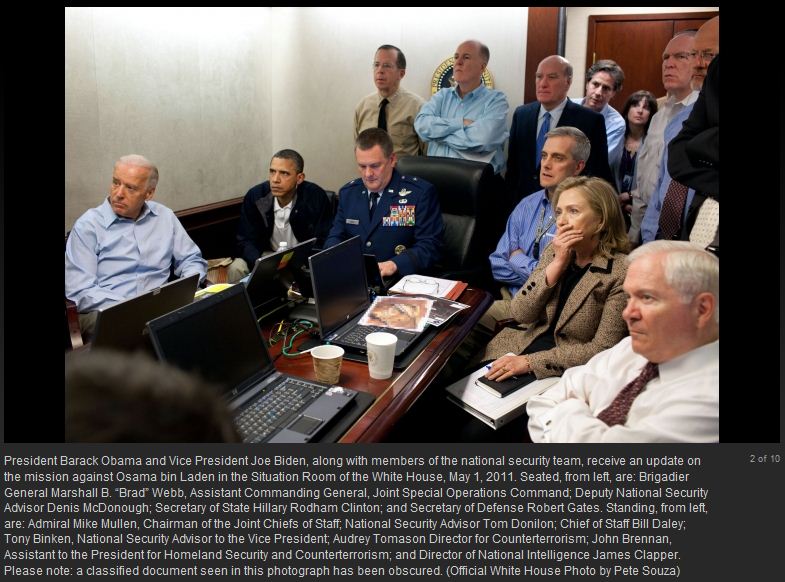
A number of websites (and major newspapers) covered the fact that more than one Hassidic Newspaper edited Secretary of State Hillary Clinton and Counterterrorism Director Audrey Tomason out of the photo the White House published of the officials in the situation room on May 1 2011 waiting for the outcome of the bin Laden raid.

Original White House Picture:

This is not just an example of people rewriting history in order to make it more palatable ideologically this is an example of a kyriarchy aggressively thrusting a specific subset of the human race out of the public sphere. And make no mistake about it, refusing to show pictures of women (on the grounds of sexual modesty) does more to sexualize and objectify those women than would showing pictures of them naked. It is pointless to argue that the opportunities of women are not limited by the fact that they cannot be pictured just because no law says that a woman cannot own a newspaper or a television station. To function effectively in the public sphere one must be visible in the public sphere.

Prime Minster Julia Gillard (Australia), Secretary of State Hillary Clinton (United States) and Michelle Obama (First Lady, United States) at the International Women of Courage Awards

If women cannot be seen then women are dependent on men deciding that women\’s issues are of importance. Imagine an award ceremony such as that pictured above if the public face of courageous women was a man (or a blank space.) No money could be raised, no discussions could be held if no man felt the issue to be important.

Imagine how difficult it would be for any woman to run for office if her male opponents could appear on television and be seen and heard debating and she was but a smudge mark on a photograph. Politicians must be seen to be doing their work.

Prime Minister Julia Gillard at a community cabinet in Australia

Prime Minister Sheikh Hassina of Bangladesh presiding over a joint meeting of the NDC and DSCSC at Armed Forces Division in Dhaka Cantonment.

Not showing pictures of woman allows members of the kyriarchy to live in a world in which, obviously, women aren\’t needed/useful in the public sphere since we have the photographic evidence that despite their absence the required functions of governments, institutions and organizations carry on. Yes, you might argue that a little girl need not actually see a picture of woman president/prime minister/doctor/lawyer/astronaut/writer/athlete in order to dream of being one herself but one wonders how hard to is to dream of working hard so that one can be obliterated from the pages of history.

If I could ask those men who wish to erase from the newspapers and history the images of all women one question it would be…..

What would Golda Meir think?

Golder Meir, Prime Minister of Israel 1969-1974

Note: All the above pictures are in the public domain. Each was available on the official website of the country in question.

Book Review: The Eye of Osiris: A Dr. John Thorndyke Story

The Eye of Osiris: A Dr. John Thorndyke Story by R. Austin Freeman (1911)

Sometimes one is disappointed when reading a “classic” wondering just what it was that made others rate a book so highly. That has happened to this reviewer often enough to make approaching “must-reads” and “classics” filled with trepidation. In this case, however, the reasons why so many have included this book on their lists of “great mysteries” are obvious. This is a delightfully written, nicely-placed and eminently fair example of detective fiction.

Freeman makes the interesting choice of having the book written from the point of view of Paul Berkeley, a recently qualified doctor and former student of Thorndyke. Jervis, the narrator of the first two Thorndyke books, has not disappeared but it is no longer through his eyes that the reader witnesses events. This allows the narrator to not see all that Thorndyke does without making him irredeemably slow and unteachable.  Thus there are times that the reader, already familiar with Thorndyke’s methods, will be able to infer more from things that Berkeley hears, sees or read than does he.

Beyond here there lie spoilers.

In addition to providing the reader with an excellent story of deduction and reasoning Freeman also writes one of the few believable and sympathetic love stories this reviewer has come across in the detective and mystery stories written at this time. Ruth is not simply a sweet Victorian girl she has a believable personality and an interesting mind. One understands exactly why Berkeley is drawn to her and one can watch the way their relationship progresses from being strangers, to individuals with shared interests, to becoming friends and then realizing that they have fallen love. None of it is strained nor is it extraneous. Berkeley is given believable motivations for his actions through the book.

Freeman plays so fairly with his readers that if the reader is well-versed in the detective fiction of the time they will have suspicions and inklings of understanding before at the end the truth is revealed. Yet this in no way diminishes from the enjoyment of following the story and from finding out the indications and clues one missed. No anvils are used nor does the author fall back on obfuscation.

This reader regretted the moment when the last page was turned and the story ended but then was cheered by the knowledge that there is another Thorndyke book on the “to read” shelf.

Rating: 4-1/2 stars

Book Review: John Thorndyke\'s Cases

John Thorndyke\’s Cases by R. Austin Freeman (1909)

This book is, as the title indicates, a collection of Thorndyke’s cases. Freeman seems to be “trying out” different approaches to writing detective fiction and so the cases vary from almost painfully complex to straightforward. The degree to which Jervis, and the reader, are included in the process of detection also varies from story to story. It would be tempting to presume that the more complex the method of crime the more the reader would be excluded from the ability to at least share in some of Thorndyke’s suspicions however this proves not to be the case. Although not all the stories are equally successful at mixing ingenuity and charm with serious detection this reader was left with the urge to immediate pick up the next Thorndyke book and start reading it.

 Rating: 3 stars