The Blandings Break Their Fast: Mr. Blandings and the directed negotiated reading, part four

Spoiler Warning: Discussion of the differences among the three presentations of the Blandings story will necessarily involve implicit and explicit spoilers

Jim Blandings, having survived his morning shave, is now sitting at his dining room table drinking a cup of coffee and reading the morning newspaper. Muriel and the children (Joan and Betsy) are breakfasting with him. Jim turns the papers of the paper and notices that a small piece has been cut out. Jim demands to know who \”did it\” and after Betsy indicates that it was she, goes on to complain:

Haven\’t I repeatedly told you not to cut up the paper until I\’ve read it?

When Betsy explains that she used it to complete an assignment handed out by her teacher without asking for any details Jim snidely comments, \”Another of Miss Stellwagon\’s so-called progressive projects?\” Muriel responds by admonishing Jim — asking him what the point is of sending his daughters to an expensive school if \”you undermine the teacher\’s authority in your dining room?\” Jim responds by arguing that since he is in the advertising business, \”[k]eeping abreast of the times is important.\”

Jim finally invites his daughter to read her finished assignment to him and Betsy fetches her notebook off the nearby sideboard as she explains:

Miss Stellwagon has assigned us to take a classified ad and write a human-interest theme on it.

Jim protests that he would like to have his breakfast without \”social significance.\” Betsy reads the assignment:

Forced to sell.
Farm dwelling.
Original beams.
Barn.
Apple orchard.
Trout stream.
Seclusion.
Superb view.
Will sacrifice.

Jim is not impressed. To him the ad is simply an example of someone trying to sell something and make some money. When his daughters quote Miss Stelwagon\’s description of advertising as a parasitic profession Jim counters by pointing out that is his job in advertising that pays for his daughters\’ tuition.

Since the writer of the original Mr. Blandings short story and novel (and co-writer of the film) was himself an advertising man living in New York City he had no doubt had sentiments expressed to him similar to those the Blandings children bring home from school. The criticism of advertising as the means of encouraging people to spend more than they have on things that they would not otherwise have desired predates the Second World War. So why did the writers have Blandings put forward such a weak defense of his profession?

I think that this is one of the ways in which the movie allowed for negotiated and counter-dominant readings. The audience experiences the events on the screen through the POV of Jim Blandings. They are encouraged to root for Jim throughout the movie. At the same time the screenplay allows room for the audience to mock Blandings as a victim of his own propaganda. He defends encouraging other people to buy things that they don\’t need with money they don\’t have. And soon the Blandings will be building a house that they don\’t need and in the process run through money they had had no intention of spending.

So, the audience member who watches the \”typical\” New York family have breakfast served to them by their maid while criticizing the teachers at their daughters\’ expensive private school can have the enjoyment of feeling that Jim and Muriel are headed to disaster.

If Jim had responded to his daughter by explaining that it was advertising that fueled the American capitalist engine and that, indeed, making other people buy things they couldn\’t afford and would not want otherwise was the very heart of his job. In fact it was at the very heart of the booming post war American economy. Jim would have been right but his rightness would have alienated him from parts of the audience and cut off avenues of negotiated readings of the scene.

It is a fine line that the writers/director walk and it speaks to the skill with which they did so that one may not even notice that a line is being walked until one has watched the film several times.

Timeline glitch Jim complains about Betsy having cut something out of his morning paper. Exactly when did she do this? Apparently the ad was cut out, put into her notebook and she wrote an assignment based on it in the few minutes between showering and having breakfast.

Bookish Thoughts: Translating genius

Kit Whitfield‘s excellent series of deconstructions / analyses of the first sentences of famous and notable books has fostered in me the habit of thinking of “first sentences” as I reshelve my books. So, earlier today I noticed my copies of Eugénie Grandet as I filed some of my Austens away, and pulled them out to consider whether I should nominate the first sentence of that book for analysis. But which first sentence I wondered, the English or the French. The English first sentence didn’t completely evoke the French book that I remembered. So I sat down and read the first several pages in French and then in the English of more than one translation. All of which made me think about the problem of translations. We talk about reading The Iliad or The Aeneid or The Bible or Beowulf but few of us are actually reading the words originally written. We are experiencing these works of genius through the eyes and minds of translators. So we do not really have, as readers, an opinion about any of those works–we have an opinion of those works as mediated by those who translated them.

Look, for example, at the first several hundred words of Eugénie Grandet:

One of the challenges of the reader who wishes to read a book written in a language they themselves cannot read is to select the best translation. Readers may fall back on the advice of reviewers or use the literary reputation of a proxy, for example an editor or series such as “Penguin Classics.”Of course the choice challenge presupposes that the reader has access to more than one translation. It also suggests that there is a single “best” translation for all readers. In many cases neither is true.

Note #1: for those who don’t read French–just skim down to the English translations. The point I am making in this piece does not require knowledge of that language.

Note #2: in French there are several more sentences before the first paragraph ends. The different font colours indicate the places in the text translators added paragraph breaks.

This is how Honoré de Balzac’s Eugénie Grandet begins:

Il se trouve dans certaines provinces des maisons dont la vue inspire une mélancolie égale à celle que provoquent les cloîtres les plus sombres, les landes les plus ternes ou les ruines les plus tristes. Peut-être y a-t-il à la fois dans ces maisons et le silence du cloître et l’aridité des landes et les ossements des ruines. La vie et le mouvement y sont si tranquilles qu’un étranger les croirait inhabitées, s’il ne rencontrait tout à coup le regard pâle et froid d’une personne immobile dont la figure à demi monastique dépasse l’appui de la croisée, au bruit d’un pas inconnu. Ces principes de mélancolie existent dans la physionomie d’un logis situé à Saumur, au bout de la rue montueuse qui mène au château, par le haut de la ville. Cette rue, maintenant peu fréquentée, chaude en été, froide en hiver, obscure en quelques endroits, est remarquable par la sonorité de son petit pavé caillouteux, toujours propre et sec, par l’étroitesse de sa voie tortueuse, par la paix de ses maisons qui appartiennent à la vieille ville, et que dominent les remparts. Des habitations trois fois séculaires y sont encore solides quoique construites en bois, et leurs divers aspects contribuent à l’originalité qui recommande cette partie de Saumur à l’attention des antiquaires et des artistes. Il est difficile de passer devant ces maisons, sans admirer les énormes madriers dont les bouts sont taillés en figures bizarres et qui couronnent d’un bas-relief noir le rez-de-chaussée de la plupart d’entre elles. Ici, des pièces de bois transversales sont couvertes en ardoises et dessinent des lignes bleues sur les frêles murailles d’un logis terminé par un toit en colombage que les ans ont fait plier, dont les bardeaux pourris ont été tordus par l’action alternative de la pluie et du soleil. Là se présentent des appuis de fenêtre usés, noircis, dont les délicates sculptures se voient à peine, et qui semblent trop légers pour le pot d’argile brune d’où s’élancent les oeillets ou les rosiers d’une pauvre ouvrière. Plus loin, c’est des portes garnies de clous énormes où le génie de nos ancêtres a tracé des hiéroglyphes domestiques dont le sens ne se retrouvera jamais. Tantôt un protestant y a signé sa foi, tantôt un ligueur y a maudit Henri IV.[1]

Here are the first two paragraphs of Marion Ayton Crawford’s Penguin Classic translation[2] of the same book:

In some country towns there exist houses whose appearance weights as heavily upon the spirits as the gloomiest cloister, the most dismal ruin, or the dreariest stretch of barren land. These houses may combine the cloister’s silence with the arid desolation of the waste and the sepulchral melancholy of ruins. Life makes so little stir in them that a stranger believes them to be uninhabited until he suddenly meets the cold listless gaze of some motionless human being, who face, austere as a monk’s, peers from above the window-sill at the sound of a stranger’s footfall.

One particular house front in Saumur possesses all these gloomy characteristics. It stands at the end of the hilly street leading to the castle, in the upper part of the town. This street, which is little used nowadays, is hot in the summer, cold in winter, and in some places dark and overshadowed. One’s footsteps ring curiously loudly on its flinty cobble-stones, which are always clean and dry; and its narrowness and crookedness and the silence of its houses, which form part of the old town and are looked down upon by the ramparts, make an unusual impression on the mind. There are houses there which were built three hundred years ago, and built of wood, yet are still sound. Each has a character of its own, and their diversity contributes to the essential strangess of the place, which attracts antiquaries and artists to this quarter of Saumur.

Here is how Katharine Prescott Wormeley’s translation[3] begins:

There are houses in certain provincial towns whose aspect inspires melancholy, akin to that called forth by sombre cloisters, dreary moorlands, or the desolation of ruins. Within these houses there is, perhaps, the silence of the cloister, the barrenness of moors, the skeleton of ruins; life and movement are so stagnant there that a stranger might think them uninhabited, were it not that he encounters suddenly the pale, cold glance of a motionless person, whose half-monastic face peers beyond the window-casing at the sound of an unaccustomed step.

Such elements of sadness formed the physiognomy, as it were, of a dwelling-house in Saumur which stands at the end of the steep street leading to the chateau in the upper part of the town. This street—now little frequented, hot in summer, cold in winter, dark in certain sections—is remarkable for the resonance of its little pebbly pavement, always clean and dry, for the narrowness of its tortuous road-way, for the peaceful stillness of its houses, which belong to the Old town and are over-topped by the ramparts. Houses three centuries old are still solid, though built of wood, and their divers aspects add to the originality which commends this portion of Saumur to the attention of artists and antiquaries.

In each case the translator was faced with the same task. They needed not to translate Balzac’s original word for word but meaning for meaning and theme for theme. They needed to use words to paint the picture that Balzac wanted his readers to have of that town and that house. Balzac’s style was inextricable from his themes. Yet the translator is also faced with the task of translating the original book so that it is accessible and understandable to readers who come from a different literary tradition. Such a reader might respond quite differently to the paragraph and sentence structure of the original that would have someone from the original audience. The (French) opening of the book is an extended word picture of a time and place. The sound of the language carries part of the load of “setting the scene.” Reading the French out loud carries quite a different feeling than reading the English out loud.

Each translator chose to break up the original long, uninterrupted opening, into smaller paragraphs. I don’t know to what degree the existence of earlier translations affected the two quoted above, however both chose to insert paragraph breaks at the same points in the text. I have read other translations that inserted them at different points.

To get a sense of just how difficult it is to pick the “best” translation consider the following. I originally read Eugénie Grandet in French. I was looking for an English “version” more for annotations and footnotes than for a translation of the words since I was sure that I was missing some elements of the book that readers of Balzac’s time would have appreciated. I agree that for the modern reader, especially for the modern reader brought up within the styles dominant in the English reading world, stylistic changes may make the book more readable. However, in my opinion, none of the translators quite nails that opening sentence. None of them are able to translate Balzac’s opening into one that would repay the type of attention Kit Whitfield brings to the opening sentences she has analyzed.

None of this should be taken as a criticism of translators in general or these translators in particular. Perhaps Balzac’s opening sentence could only be translated into English by Balzac himself–if he was fluent in the language. Perhaps the particular quality of that sentence cannot be duplicated in the English language. I don’t know. I do know that the more I grapple with that single sentence the greater my admiration and respect for translators.

Note #3: One of the wonderful bonuses of Kindle/Amazon ebooks is that one is usually offered the option to download a sample of the book, generally the first chapter. This allows readers the opportunity to browse books much as one would in a book store or library. One doesn’t need to own a Kindle to do this. The “Kindle for your computers” software is available for free. The sample chapter is downloaded to your computer and you can peruse it at your leisure. I looked for an number of translations of Balzac’s books before I wrote this piece and ended up buying my third copy of the book.


[1] Eugénie Grandet is in the public domain. The French text in this article is from the version on the Gutenberg.org website. insert footnote

[2] Balzac, H. Eugénie Grandet. Harmondsworth, Middlesex: Penguin Books, 1955.

[3] Also available on Project Gutenberg.

100 years ago today: One of these things is not like the other

Headlines on the front page of November 10 1911 issue of The San Francisco Call (California) [NOTE: Like many newspapers of the day The Call used multiple stacked headlines for many articles. Where there are more than two headlines in the original not all of the \”lesser\” headline are included below. The original capitalizations/spellings have been retained where possible. In a few cases the words are \”best guesses\” due to the condition of the scanned newspapers]:

  • REBELS FALL BACK FROM NANKING LEAVING 1,000 DEAD / Manchu Dynasty in Last Desperate Stand Holds but Two Strategic Points
  • ROLPH BEGINS HIS TASK PLANS LAID TO BUILD UP CITY / SUPERVISORS TO ORGANIZE PRIOR TO NEW REGIME
  • TWO MEN ARE MISSING AFTER GAS EXPLOSION / Others Are Seriously Burned by Fire Which Swept Hunters Point Drydock
  • PRINCE APPLAUDS MINISTER\’S CRITICS / Von Bethmann-Holweg Defends Morocco-Congo Pact in Reichstag
  • WOMAN SUSPECTED OF SLAYING THREE / Chicago Has a New Chain of Deaths Resembling the Vermilya Case
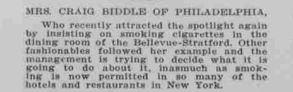
  • MRS. CRAIG BIDDLE SMOKES IN PUBLIC / Philadelphia Society Leader Puffs \”Cigawette\” in Believue=Stratford Restaurant
  • THOUSANDS HIDDEN BY WOMAN FOUND / Cobwebbed Corners in House Where She Died Yield Small Fortune
  • MAN SCARED DUMB BY \”COP\’S\” GREETING / Chicagoan Had to Get\” Doctor to Find Lost Voice
  • \”GOLDEN RULE\” CHIEF ORDERED ON DUTY / Doctor Certifies Kohler\’s Physical Condition. Is \”Good\”
  • ALLEGED RUSSIAN ANARCHIST JAILED / Teofil Klempke Held at San Luis Obispo as Terrorist
  • MAETERLINCK GIVEN 1911 NOBEL PRIZE / Noted (Belgian Author Wins Award for Literature
  • HUSBAND SOLD WIFE FOR CENT AND HALF / Admits Deal With Former Convict; Calls It a Jest
  • TARKINGTON IS SUED FOR $10,000 DAMAGES / Author in Europe When Chauffeur Ran Down Man
  • PARSON AND BROTHER LOCKED UP AS SPIES / Italians Arrested Ohio Citizens on Sightseeing Tour

All save one are about foreign affairs, crimes, actions of public officials or institutions. Save one. Mrs. Craig Biddle was in the news for having broken the norms for the performance of social place. Since she was wealthy and a member of \”society\” and since her actions took place in an expensive, although public, venue she was stared at rather than being hounded, arrested or physically chastised.

Mrs. Biddle\’s actions took were in a place considered \”public\” and therefore her defiance of the public norms of gender performance were seen by the editors of the time as newsworthy. Her actions were particularly troublesome to the behavioural norms of the time because she was wealthy and well connected. If poor woman, women of colour, women who were immigrants or the children of immigrants, violated the social norms then their acts were understood and reported as a commentary of the shortcomings of the women in question. When a women as well educated, wealthy and well versed in social norms acted as did Mrs. Biddle then the social norm, as much as the woman, was in danger of being held up for examination and criticism.

For those who are imagining that both the write-up of this article and the choice to put it on the front page is due to the fact that the newspaper in question is the product of a small town and produced by people who are at best part time newspaper writers and editors that is most certainly not the case. Not only is San Francisco at this point in time a fairly large city, this is not a local story. Mrs. Biddle\’s act took place in Philadelphia and the story in the local Philadelphia paper was picked up and distributed nationally. For example, you can find a similar headline SOCIETY STIRRED AS MRS. BIDDLE SMOKES IN PUBLIC / Philadelphia\’s Social Mentor Daintily Puffs Cigarette in Fashionable Restaurant in The Evening World (New York, page 21) on the same date. This write up on page 37 of the December 23 1911 issue of Godwin\’s Weekly (Salt Lake City, Utah) gives some sense of how seriously people were taking Mrs. Biddle\’s actions:

The important thing to remember is that in 1911 women still did not have the right to vote in much of the United States. They could not sit on juries. They had limited access to, and rights in, the public sphere. We might now look back and laugh off Mrs. Biddle\’s actions as silly and even dangerous to her health. And Mrs. Biddle may have chosen to smoke in a public place simply to demonstrate her social prominence. Yet in a way Mrs. Biddle was a pioneer of women\’s rights to the full enjoyment of citizenship just as were women who were campaigning to extend suffrage to women as well as men.

The casual cultural colonialism of the gentleman archeologist

The following conversation takes place in E. F. Benson short story Monkeys between two Englishmen (a surgeon and a gentle archaeologist) about the details of the latter\’s current work in Egypt:

\”But odder still are those old Egyptians of yours, who thought that there was something sacred about their bodies, after they were quit of them. And didn\’t you tell me that they covered their coffins with curses on anyone who disturbed their bones?\”

\”Constantly,\” said Madden. \”It\’s the general rule in fact. Marrowy curses written in heiroglyphics on the mummy-case or carved on the sarcophagus.\”

\”But that\’s not going to deter you this winter from opening many as many tombs as you can find, and rifling from them any objects of interest or value.\”

Madden laughed.

\”Certainly it isn\’t,\” he said. \”I take out of the tombs all objects of art, and I unwind the mummies to find and annex their scarabs and jewellry. But I make an absoulte rule always to bury the bodies again. I don\’t say that I believe in the power of those curses, but anyhow a mummy in a museum is an indecent object.\”

\”But if you found some mummied body with an interesting malformation, wouldn\’t you send it to some anatomical institute?\” asked Morris.

\”it has never happened to me yet,\” said Madden, \”but I\’m pretty sure I should.\”

\”Then you\’re a superstitious Goth and an anti-educational Vandal,\” remarked Morris…. [\”Monkeys\” in Benson, E. The Collected ghost stories of E.F. Benson. New York: Carroll & Graf, 1992., pp. 556-557]

Readers who know E. F. Benson only through his Mapp and Lucia books, a comic series of novels set in mostly the \”quaint\” English communities of Tilling and Rye and concerned mostly with the efforts of Emmeline Lucas (Lucia) and Miss Mapp to rule over social set, would probably read the above conversation as a humourous (and not particularly well informed) parody gentle surgeons and archeologists. But Benson is not speaking from ignorance or glancing acquaintanceship with such men. Benson knew well the society in which both these characters can be presumed to have grown up just as he also knew well the world of the classically educated, upper class gentlemen archeologist.

Benson was himself the son of an Archbishop of Canterbury and graduated from Cambridge with a degree in archeology. After graduating he worked on archeological sites in Britain, Egypt and Greece. This is a world in which he worked for many years. The casual way in which these two Englishmen treat the graves of other people, the religious beliefs of the other people and even the right of other people to own and control their countries (and the bones of their ancestors) is carefully drawn in this and other stories.

Morris condemns as superstition Madden\’s willingness to at least rebury the bodies from the graves he is plundering. Madden feel no compunction about taking upon himself the decision as to whether to rebury the bones he finds or to \”donate\” them to a museum. It is clear that to both men the Egyptians of the day had no right to determine the fate of their own country, their own people and their own treasures.

Neither of these men is a villain. Each believes that he is acting for some greater \”scientific\” good. It is interesting, however, that the scientific good always aligns with that which is of most utility or benefit to them. As Benson shows us, the gentlemen archeologists of England did not twirl their waxed mustaches as they plundered the many civilizations within the British empire. They were sometimes almost excessively polite. They explained, to any \”native\” who dared expostulate that what they were doing was wrong, that to stand against them was to stand against progress, science and Britain\’s imperial destiny.

Polite, gentlemenly plunderers—-but plunderers all the same.

The sources of our discontents

Every weekend The Slacktiverse posts a \”blogaround.\” Most, but not all, of the links are to posts published over the last week by members of the The Slacktiverse community [Section One]. A small number of links are to stories that one person in the community thinks others in the community may be interested in [Section Two]. There are usually a link or two to a petitions [Section Three].

While formatting the first section of the weekly post (links to posts published on elseboards) is reminiscent of copy editing working on the latter two sections is far more similar to serious academic research or old fashioned newspaper fact checking. Fact checking is a skill which is not well taught (if it is taught at all) at school and yet is a vitally important tool when one is assessing validity and weight of any information.

A short primer on fact checking

  1. Whenever possible use primary sources. Just because source ZZ says/writes that Person A said Y in interview N doesn\’t mean that they actually did so. In a surprisingly large number of instances Person A said no such thing. Or Person A did write/say that but not in interview N. It is possible that Person B was actually the one who said that. It is possible that Person A said one thing in interview N and later said the opposite in interview M. It is possible that Person A never said anything on that topic at all.

    Does this mean that source ZZ consciously mischaracterized (lied about) what Person B said/wrote? Not necessarily. The secondary source could themselves have been depending on another nonprimary source (that is, technically the secondary source was actually a tertiary source) or the secondary source may have misremembered or misunderstood the primary source. The reasons why it happens are less important than the fact that it does happen.

  2. Assess the credibility/expertise/informedness of the secondary source.
  3. Consider the possiblity that the secondary source may have reasons, conscious or unconscious, for being less than objective about the primary source. Is the secondary source a relative, friend, follower, leader, proponent or opponent of the primary source or the institution/person/beliefs the primary source was commenting on? Their judgement might be in question. And even if their judgment/objectivity is beyond question do they know enough about the subject/issue/event/person to make a good determination as to the accuracy/validity of the primary source? This is of particular importance when the material cited cannot be judged without some level of skill. For example, if one is not fluent in Homeric Greek it is difficult to access the relative qualities of different translations and if one knows little about statistics one cannot vouch for the quality of any statistical analyses. So ZZ may have simply not have had the training required understand and summarize the work they were referencing.

  4. Check to see whether further information casts doubt on the claims of the primary source If one reads/researches enough one soon finds sources that state, without the least amount of equivocation, that one will find dragons in this area of the Europe and sea monsters in that part of the ocean. You will find sources that claim to have proof that lead has been turned into gold, that a certain saint levitated and then flew around a cathedral and that some historical figures were hiding tails under their cloaks. Just because a primary source said the something was true doesn\’t mean that it was indeed the case. Often it takes little more than reading/listening to the primary source in order to discount it claims . This is sometimes the case even when the original work was done comparatively recently. For example, a particular political/psychological study was conducted within the last forty years. In the introductory material the authors emphasized that they had made special efforts to obtain a sample that was diverse enough to warrant generalization to the wider American population. On careful reading of the study it emerges that the samples were from two American college towns in the same general area of the country.
  5. Bad information doesn\’t disappear. Just because something is in the library or on the internet doesn\’t mean that it hasn\’t been refuted somewhere else. Books full of bad information don\’t get recalled and they don\’t have warning notices pasted to their front covers. Internet sites are not taken down when it turns out the material on the page has been proven wrong. Always look for independent verification.
  6. Always check to make sure that the \”independent\” proofs/references are actually independent Check all the references in the secondary sources. One sometimes finds that all the many references in your secondary sources lead to same, single, initial source. For example, one person may post an account of a bad experience with a particular store or institution on facebook. Someone reads about it on facebook and writes it up in their college newspaper. The local town newspaper picks up the story from the college newspapers. A larger regional newspaper picks up the story from the town newspaper. A website reports on the bad experience using the article in the regional newspaper as verification of the information in the original facebook posting. At no point has anyone made an effort to independently verify the claim in the facebook article.

100 years ogo today: I wonder what happened to Rosemary\'s baby?

One of the headlines on the front page of The Sun (New York, Nov. 7, 1911) gave me a momentary chill ROSEMARY FINDS A BABY. The story that followed evoked little of the famous book by Ira Levin or even more famous movie directed by Roman Polanski. On the surface it is a sweet human interest story but if one ponders the unexplored implications it becomes less sweet and more disturbing.. The Rosemary of the headline was the eight year old daughter of a New York banker. Playing in the kitchen one evening she thought she heard, over the sound of the rain, the cry of a kitten or a puppy. When she opened the door to investigate she found that the cries were actually coming from a small (they later estimated about 3 weeks old) baby. Rosemary and Mary (the family cook) brought the baby, dressed in clothes that were soaked through from the rain, into the kitchen. The baby boy was washed, dried, given some hot milk by spoon and brought up to the family dining room while the family ate dinner. Then Mr. Hollister, Rosemary\’s father, sent for the local police who came and took the baby away. Mr. Hollister inquired of them what would happen to the infant and he was told it would probably be sent to Bellevue.

Later that evening Rosemary saw a young woman standing in the same area where they previously found the baby. She ran when she realized she was being watched. Rosemary chased her to ask if she had been looking for a baby and the young woman responded that she had been looking for a friend.

The New York Evening World ran a longer version of the same story on page 8 LITTLE ROSEMARY FOUND BABY LIKE IN FAIRY STORY with many sentimentalizing details — but note, it is the eight year old daughter of the banker who is sentimentalized in the story. The writer describes to the reader \”touching\” details of the way in which Rosemary was eager the next morning to call to find out how \”her\” baby slept during its first night on the ward at Bellevue. The baby is small, it gurgles and brings Rosemary great joy. But there is not even a passing query as to why the child was left or what might have driven its mother to do so. The Hollisters are clearly well off since they have a cook, a butler, a footman and other servants. Did the baby\’s care-givers think that this comfortable family might take their child in? Did they realize that after drying him off the Hollisters would hand him over to the police who would in turn deliver him Bellevue where he would become just another abandoned child for them to minister to?

There is no prominent follow-up to this story in either newspaper the next day. Which is not surprising since the story was not actually about the baby (who remains nameless) or the mother (whose existence is but hinted at in the article.) The story is about the exquisite sensibilities of Rosemary Hollister. Having told the \”sweet\” story of the wealthy little girl who \”found a baby\” and was still excited about it the next day the newspaper moves on to other stories because to write more would involve asking questions that might make the readers feel uncomfortable. And so the story faded from view to be replaced the next day by different human interest stories.

But the story isn\’t over in my mind. I wonder if the young woman was the mother of the abandoned baby. Or perhaps a friend or relative of the mother. I wonder what happened to the little boy. Mr. Hollister had asked the police to let him know where they sent the infant. Perhaps, I hoped, Mr. Hollister would wake an interest in the child.

I wonder if the child had been put in a somewhat sheltered areaway while the woman who was looking after it searched for food. Had she been forced to resort to prostitution and had, she thought, tucked the child somewhere where no harm could come to it? Was Mr. Hollister the father and had the mother left the child by his kitchen in the hope that he would look after it.

I wonder what happened to \”Rosemary\’s\” baby?

100 years ago today: Pensions for public service workers were in the news in Washington, DC

100 years ago today one of the headlines on the front page of The Washington Herald (DC, November 6, 1911) reads:

PENSION DEFICIENCY SHAME TO DISTRICT / Washington Lags Behind Other Large Cities / PROTECTORS NEGLECTED

The article goes on to compare the ways in which pensions and benefits are provided for/guaranteed in Washington DC with other major American cities (Detroit, New York, Cleveland, Chicago, Philadephia….) The writers argue that the situation leaves the city open to an emergency and that those who protect their fellow citizens should not ever be dependent on private charity for the benefits that they have earned from years of service and dangerous work.

An article in The Washington Times (page 2) on the same day frames strongly protected pensions as something the chamber of commerce supported:

\”The business men of Washington believe with the Commissioners,\” said Mr. Gude, \”that Congress should make provision for their pension fund being kept up to the mark by permanent appropriation. It is not a matter of charity but of duty and the needs of the fund should be supplied by all the tax-payers.

It is fascinating to look back over 100 years and see public service/government pensions and benefits being framed not only as prudent but morally required by the very businessmen who are now being claimed as role models by modern political activists who wish to gut public service pensions and benefits.

Book Reviews

Books reviewed elsewhere are listed further down the page. Books reviewed on this blog are listed directly below, in alphabetical order, with links to the full reviews. 

Ankle Deep (Angela Thirkell)
August Folly (Angela Thirkell)
Before the Fact (Francis Iles) 
Clouds of Witness (Dorothy L. Sayers) Wimsey 02
Diary of a Provincial Lady (E. M. Delafield)
Earth Abides (Gordon R. Stewart)
Excellent Women (Barbara Pym)
The Eye of Osiris: A Dr. John Thorndyke Story (R. Austin Freeman)
The French Powder Mystery (Ellery Queen) Ellery Queen 02
Lucia in London (E. F. Benson)
The girl with the dragon tattoo (Stieg Larsson)
High Rising (Angela Thirkell)
Instructions for American Servicemen in Iraq during World War II
Jane and Prudence (Barbara Pym)
John Thorndyke\’s Cases (R. Austin Freeman) 
Miss Mapp (E. F. Benson)
Mapp and Lucia (E. F. Benson)
Paying Guests (E. F. Benson)
The Poisoned Chocolates Chase (Anthoney  Berkeley)
Queen Lucia (E. F. Benson)
The Red Thumb Mark (R. Austin Freeman)
The Spanish Cape Mystery (Ellery Queen) Ellery Queen 09
Tiassa (Steven Brust)
Unnatural Death (Dorothy L. Sayers) Wimsey 03
The Virgin Heiresses (aka The Dragon\’s Teeth) (Ellery Queen)
Whose Body? (Dorothy L. Sayers) Wimsey 01
Wild Strawberrues (Angela Thirkell)

BOOKS REVIEWED ELSEWHERE

The Amateur Cracksman (E. W. Hornung)
An Autumn Sowing (E.F. Benson)
Desirable Residences (E. F. Benson)
\”E\” is for Evidence (Sue Grafton)
In a strange city (Laura Lippman)
Let\’s Kill Uncle: A Novel (Rohan O\’Grady)
Lucky Stiff (Deborah Coonts)
The Man in the Queue (Josephine Tey)
Mistress of Molecules (Gerald M. Weinberg)
Pet Noir (Pati Nagle)
The Riddle of the Sands  (Erskine Childers)
The Roman Hat Mystery (Ellery Queen) Ellery Queen 01

Book review: Diary of a Provincial Lady

Diary of a Provincial Lady by E M Delafield (1931)

Occasionally, upon reaching the end of a book, a reader may find hirself unsure as to exactly how to rate/categorize it. This is exactly how I felt when I reached the last line of Delafield’s Diary of a Provincial Lady. The book is either a light, enjoyable and forgettable read or a masterpiece. It is either wittily mundane or relentlessly subversive.

Let me digress for a moment before getting to the heart of this review to explain that the way I “discovered” this book and my own experience of reading it play major roles in my reception of it.

How I experienced Delafield

This is one of those books which made me actually laugh out loud while reading it. Not small giggles or demure chuckles but resounding belly laughs that were loud enough to bring the spouse in from some other room to ask “what’s so funny?” Each time this happened I would read the passage in question out loud (often barely able to do so without breaking into laughter again) and each time the spouse would respond with at a polite smile. “Yes,” zie would say, “quite amusing but it probably misses quite a bit from being out taken out of context.”

And that, of course, was the point. Delafield is not an author who can appreciated in excerpt or digest form unless the reader is already familiar with her style and created universe.

How I \”discovered\” Delafield

Much as the sentences in the book can be better appreciated in the light of all of the other sentences in the book, the experience of reading the book is further enriched, and indeed may only be fully achieved, if the book was read in the context of the other books published at the same time.

I \”discovered\” Delafield because of references made to her work among reviews of Angela Thirkell’s books. I would never have read Thirkell had not someone who read my reviews of E. F. Benson suggested her to me. I would not have reviewed E. F. Benson in the same manner had I not carefully placed Benson into the context of his time.

For today\’s reader E. F. Benson’s books might be understood/received differently if zie realizes that Benson set his stories in the same England (and to a large degree about the same types of people) as did Agatha Christie, Margery Allingham, Ngaio Marsh and even, heaven forfend, H. C. Bailey. It is only when comparing the different ways in which these authors portrayed English society (given their varied backgrounds) that one can begin to see in full the larger story they were, probably unintentionally, telling.

The way in which Benson wrote about the gentry was informed by his own place within that class. Benson was the son of an Archbishop of Canterbury, the brother of prominent writers and thinkers and a very successful novelist and short story writer. Benson grew up, and lived, around people who were financially and socially secure. While Thirkell was technically part of that same class there were times in her life (especially when she was living in Australia) when she endured serious economic and physical hardships. She and Benson both made a living from their writing but Thirkell wrote to achieve a standard of living that Benson had always been able to maintain.

Thirkell’s books were, like Benson’s, often wonderfully light and yet if one looked carefully beneath the light and witty surfaces one detected uncomfortable undercurrents of concern in the output of both authors. In Benson books the concerns often centred around how to maintain a particular place in life as well as how to fill the moments of one\’s life when, as members of the gentry, individuals were as limited in number and nature of their hobbies and philanthropies as they were in choices of careers. In Thirkell’s books those concerns often focused around money and the future as members of a class once as secure in its financial as its social place see economic (and social) changes coming for which they were unprepared. The careers and activities which Benson\’s shows members of that class indulging in will soon be neither within their financial reach nor capable of supporting them financially.

Diary of a Provincial Lady

Delafield, in Diary of a Provincial Lady, does more than just touch on these concerns, she makes them the central focus of the book. The titular Provincial Lady and her husband are of the gentry and so there are a limited number of ways in which they can fill their time. And their every hour is indeed filled and yet over the period of time covered by the book they seem, to the modern reader, to have been singularly unproductive. For example, we read little of what the Lady\’s husband\’s actual work entailed (that is, the work for which he was paid.) The work of the Provincial Lady herself appears to have been to maintain the appropriate outward signifiers that the family belonged to a particular class/social group. She does some writing that is intended for publication and she does much writing that is not. Like many of her class much of her time is spent writing reading letters from friends and acquaintances and writing letters to friends and acquaintances.

It strikes this modern reader that much of the letter reading/writing done by the characters in this and other books of the time differs little in content from the gossip exchanged by teenagers over the telephone (when I was growing up) and now by text, tweet and facebook post. So why was it not treated as simple time-wasting gossip and tittle-tattle? Two of the reasons are fairly obvious: first, it is members of society discussing the affairs of other members of society–thus it is by definition of value and in point of fact a requirement for any who wishes to negotiate the fairly complicated byways of society life at the time; and second, that which was written still carried with the rarefied patina of literacy. It is not that long since the time that comparatively few people in Britain were literate and the reading and writing of letters was a sign of being a member of gentry. Additionally, of course, the ability to afford cost of keeping up such written correspondences was a marker of class status just as was having a telephone, making \”trunk calls\” and owning a car.

And the Lady (who remains nameless throughout the book) certainly sees herself as being busy:

Query, mainly rhetorical: Why are nonprofessional women, if married and with children, so frequently referred to as \”leisured\”? Answer comes there none.)

And the modern day reader (or a reader contemporaneous to Delafield but with far less money) might note that most women did not have the luxury of extra rooms in which young children normally eat their dinner and play in the evening or staff to look after those children. Nor did most women of the time (or now) have other people to make the soup, set the table, wash the dishes, bathe the children or clean their rooms.

August 3rd.–Difference of opinion arises between Robin and his father as to the nature and venue of former\’s evening meal, Robin making sweeping assertions to the effect that All Boys of his Age have Proper Late Dinner downstairs, and Robert replying curtly More Fools their Parents, which I privately think unsuitable language for use before children. Final and unsatisfactory compromise results in Robin\’s coming nightly to the dining-room and partaking of soup, followed by interval, and ending with dessert, during the whole of which Robert maintains disapproving silence and I talk to both at once on entirely different subjects. (Life of a wife and mother sometimes very wearing.)

The response of this reader (and I imagine the response of most working class women in the 1930s) is to wonder at someone who is so acclimatized to absolute leisure that even the task of \”listening to one\’s child\” become wearisome.

One of the major preoccupations of these \”gentle\” women in \”financial distress\” is the state of the kitchens and the quality of their “help.” Having servants to \”do\” for them is a vital marker of class. However changing financial (and social) times have made it harder to \”get\” good servants. Servants had taken to asking for larger wages and refusing to devote all the hours of the day and week to service. It was still at this time not uncommon to find people who forbade their servants to use the telephone, limited the hours they could socialize, limited who they could socialize with and even \”renamed\” servants who had what they considered to be unsuitable or difficult to pronounce names. With the rising levels of education and with more non-service jobs available to women people who wished to treat their servants as vassals or people who expected to receive top-class service for mediocre wages were finding it increasingly difficult to \”get by\”:

Cook says that unless help is provided in the kitchen they cannot possibly manage all the work. I think this unreasonable, and quite unnecessary expense. Am also aware that there is no help to be obtained at this time of the year. Am disgusted at hearing myself reply in hypocritically pleasant tone of voice that, Very well, I will see what can be done. Servants, in truth, make cowards of us all.

The author has a cook, a governess/nurse for the children, a gardener and at least two maids. Yet nothing seems ever to get done and her life (from her point of view) is abundantly full of chores.The cook is invariably bad and servants invariably inefficient, emotional and prone to turning in their notice. The titular Lady never asks herself if she and her husband would get a better cook if they were willing to pay better wages. They don\’t ask themselves if the fault may lie with the employers rather than the employees. The Lady never considers how much more money she and husband would have if only she did the cooking and she looked after her children and he did more work around the house.

The answer, unfortunately, was that the Lady and her husband could NOT do those things and maintain their social place. One doubts that Robert would have kept his job. It is possible that their children would no longer be accepted at the schools which they would now be able to afford. So the Lady knows (whether or not she is aware that she knows it) that she and her family are caught in the trap of financially distressed gentility–that the most rational way in which to respond to the financial distress can only be carried out at the cost of the very thing the family was sacrificing so much to maintain: their status as members of the gentry.

So, is this book wittily mundane or relentlessly subversive? That depends on determining whether the reader is merely reading the subversiveness into the text or whether the author layered it carefully in between the seeming irrelevancies.

Delafield is clearly a technically proficient writer. For example, she captures that most mysterious and frustrating aspect of time—that it often seems to simply slip away from us. Even the most simple interactions can take an inordinate amount of time and so she (like us) looks back with wonderment at the fact that writing a few letters, running a few errands and do a few household chores can consume the better part of day and yet leave one with the feeling that nothing at all has been accomplished.

June 17th.–Entire household rises practically at dawn, in order to take part in active preparations for Garden Fete…..At ten o\’clock our Vicar\’s wife dashes in to ask what I think of the weather, and to say that she cannot stop a moment. At eleven she is still here

She is equally good at pinpointing the necessary hypocrisies of successful socializing as in here when the diarist discusses the end of “dinner out”:

Exchange customary graceful farewells with host and hostess, saying how much I have enjoyed coming.

(Query here suggests itself, as often before: Is it utterly impossible to combine the amenities of civilisation with even the minimum of honesty required to satisfy the voice of conscience? Answer still in abeyance at present.)

Structuring the book as a diary allowed Delafield to write things which would be considered astringent or cynical were they spoken out loud but come across as insightful whimsy when confided only with the page:

I notice that conversation has, mysteriously, switched on to the United States of America, about which we are all very emphatic. Americans, we say, undoubtedly hospitable–but what about the War Debt? What about Prohibition? What about Sinclair Lewis? Aimée MacPherson, and Co-education? By the time we have done with them, it transpires that none of us have ever been to America, but all hold definite views, which fortunately coincide with the views of everybody else.

(Query: Could not interesting little experiment be tried, by possessor of unusual amount of moral courage, in the shape of suddenly producing perfectly brand-new opinion: for example, to the effect that Americans have better manners than we have, or that their divorce laws are a great improvement upon our own? Should much like to see effect of these, or similar, psychological bombs, but should definitely wish Robert to be absent from the scene.)

This reader wonders (and one wonders if the author wondered) if other (or even all) of the people present at that scene) were thinking similar things?

Delafield returns frequently to scenes in which what is being said by a character is different from (and sometimes antithetical to) what that character is thinking. Similarly she repeatedly presents the reader with scenes in which was is being done is the opposite of what was planned to be done and what characters said they would do (or were doing.)

Did Delafield intentionally write Diary of a Provincial Lady to be both a whimsical and homourous examination of the quotidian concerns of the unexceptional provincial lady or as a slyly subversive examination of the futility and hypocrisy of those clinging to the social status of gentry in the face of the economic changes in English life? Repeated readings have not allowed this reader to answer that question but they have provided me with pleasure, entertainment and a greater understanding of challenges facing British provincial gentry in the 1930s.

Rating: 4-1/2 stars

Book review: Diary of a Provincial Lady

Diary of a Provincial Lady by E M Delafield (1931)

Occasionally, upon reaching the end of a book, a reader may find hirself unsure as to exactly how to rate/categorize it. This is exactly how I felt when I reached the last line of Delafield’s Diary of a Provincial Lady. The book is either a light, enjoyable and forgettable read or a masterpiece. It is either wittily mundane or relentlessly subversive.

Let me digress for a moment before getting to the heart of this review to explain that the way I “discovered” this book and my own experience of reading it play major roles in my reception of it.

How I experienced Delafield

This is one of those books which made me actually laugh out loud while reading it. Not small giggles or demure chuckles but resounding belly laughs that were loud enough to bring the spouse in from some other room to ask “what’s so funny?” Each time this happened I would read the passage in question out loud (often barely able to do so without breaking into laughter again) and each time the spouse would respond with at a polite smile. “Yes,” zie would say, “quite amusing but it probably misses quite a bit from being out taken out of context.”

And that, of course, was the point. Delafield is not an author who can appreciated in excerpt or digest form unless the reader is already familiar with her style and created universe.

How I “discovered” Delafield

Much as the sentences in the book can be better appreciated in the light of all of the other sentences in the book, the experience of reading the book is further enriched, and indeed may only be fully achieved, if the book was read in the context of the other books published at the same time.

I “discovered” Delafield because of references made to her work among reviews of Angela Thirkell’s books. I would never have read Thirkell had not someone who read my reviews of E. F. Benson suggested her to me. I would not have reviewed E. F. Benson in the same manner had I not carefully placed Benson into the context of his time.

For today’s reader E. F. Benson’s books might be understood/received differently if zie realizes that Benson set his stories in the same England (and to a large degree about the same types of people) as did Agatha Christie, Margery Allingham, Ngaio Marsh and even, heaven forfend, H. C. Bailey. It is only when comparing the different ways in which these authors portrayed English society (given their varied backgrounds) that one can begin to see in full the larger story they were, probably unintentionally, telling.

The way in which Benson wrote about the gentry was informed by his own place within that class. Benson was the son of an Archbishop of Canterbury, the brother of prominent writers and thinkers and a very successful novelist and short story writer. Benson grew up, and lived, around people who were financially and socially secure. While Thirkell was technically part of that same class there were times in her life (especially when she was living in Australia) when she endured serious economic and physical hardships. She and Benson both made a living from their writing but Thirkell wrote to achieve a standard of living that Benson had always been able to maintain.

Thirkell’s books were, like Benson’s, often wonderfully light and yet if one looked carefully beneath the light and witty surfaces one detected uncomfortable undercurrents of con cern in the output of both authors. In Benson books the concerns often centred around how to maintain a particular place in life as well as how to fill the moments of one’s life when, as members of the gentry, individuals were as limited in number and nature of their hobbies and philanthropies as they were in choices of careers. In Thirkell’s books those concerns often focused around money and the future as members of a class once as secure in its financial as its social place see economic (and social) changes coming for which they were unprepared. The careers and activities which Benson’s shows members of that class indulging in will soon be neither within their financial reach nor capable of supporting them financially.

Diary of a Provincial Lady

Delafield, in Diary of a Provincial Lady, does more than just touch on these concerns, she makes them the central focus of the book. The titular Provincial Lady and her husband are of the gentry and so there are a limited number of ways in which they can fill their time. And their every hour is indeed filled and yet over the period of time covered by the book they seem, to the modern reader, to have been singularly unproductive. For example, we read little of what the Lady’s husband’s actual work entailed (that is, the work for which he was paid.) The work of the Provincial Lady herself appears to have been to maintain the appropriate outward signifiers that the family belonged to a particular class/social group. She does some writing that is intended for publication and she does much writing that is not. Like many of her class much of her time is spent writing reading letters from friends and acquaintances and writing letters to friends and acquaintances.

It strikes this modern reader that much of the letter reading/writing done by the characters in this and other books of the time differs little in content from the gossip exchanged by teenagers over the telephone (when I was growing up) and now by text, tweet and facebook post. So why was it not treated as simple time-wasting gossip and tittle-tattle? Two of the reasons are fairly obvious: first, it is members of society discussing the affairs of other members of society–thus it is by definition of value and in point of fact a requirement for any who wishes to negotiate the fairly complicated byways of society life at the time; and second, that which was written still carried with the rarefied patina of literacy. It is not that long since the time that comparatively few people in Britain were literate and the reading and writing of letters was a sign of being a member of gentry. Additionally, of course, the ability to afford cost of keeping up such written correspondences was a marker of class status just as was having a telephone, making “trunk calls” and owning a car.

And the Lady (who remains nameless throughout the book) certainly sees herself as being busy:

Query, mainly rhetorical: Why are nonprofessional women, if married and with children, so frequently referred to as “leisured”? Answer comes there none.)

And the modern day reader (or a reader contemporaneous to Delafield but with far less money) might note that most women did not have the luxury of extra rooms in which young children normally eat their dinner and play in the evening or staff to look after those children. Nor did most women of the time (or now) have other people to make the soup, set the table, wash the dishes, bathe the children or clean their rooms.

August 3rd.–Difference of opinion arises between Robin and his father as to the nature and venue of former’s evening meal, Robin making sweeping assertions to the effect that All Boys of his Age have Proper Late Dinner downstairs, and Robert replying curtly More Fools their Parents, which I privately think unsuitable language for use before children. Final and unsatisfactory compromise results in Robin’s coming nightly to the dining-room and partaking of soup, followed by interval, and ending with dessert, during the whole of which Robert maintains disapproving silence and I talk to both at once on entirely different subjects. (Life of a wife and mother sometimes very wearing.)

The response of this reader (and I imagine the response of most working class women in the 1930s) is to wonder at someone who is so acclimatized to absolute leisure that even the task of “listening to one’s child” become wearisome.

One of the major preoccupations of these “gentle” women in “financial distress” is the state of the kitchens and the quality of their “help.” Having servants to “do” for them is a vital marker of class. However changing financial (and social) times have made it harder to “get” good servants. Servants had taken to asking for larger wages and refusing to devote all the hours of the day and week to service. It was still at this time not uncommon to find people who forbade their servants to use the telephone, limited the hours they could socialize, limited who they could socialize with and even “renamed” servants who had what they considered to be unsuitable or difficult to pronounce names. With the rising levels of education and with more non-service jobs available to women people who wished to treat their servants as vassals or people who expected to receive top-class service for mediocre wages were finding it increasingly difficult to “get by”:

Cook says that unless help is provided in the kitchen they cannot possibly manage all the work. I think this unreasonable, and quite unnecessary expense. Am also aware that there is no help to be obtained at this time of the year. Am disgusted at hearing myself reply in hypocritically pleasant tone of voice that, Very well, I will see what can be done. Servants, in truth, make cowards of us all.

The author has a cook, a governess/nurse for the children, a gardener and at least two maids. Yet nothing seems ever to get done and her life (from her point of view) is abundantly full of chores.The cook is invariably bad and servants invariably inefficient, emotional and prone to turning in their notice. The titular Lady never asks herself if she and her husband would get a better cook if they were willing to pay better wages. They don’t ask themselves if the fault may lie with the employers rather than the employees. The Lady never considers how much more money she and husband would have if only she did the cooking and she looked after her children and he did more work around the house.

The answer, unfortunately, was that the Lady and her husband could NOT do those things and maintain their social place. One doubts that Robert would have kept his job. It is possible that their children would no longer be accepted at the schools which they would now be able to afford. So the Lady knows (whether or not she is aware that she knows it) that she and her family are caught in the trap of financially distressed gentility–that the most rational way in which to respond to the financial distress can only be carried out at the cost of the very thing the family was sacrificing so much to maintain: their status as members of the gentry.

So, is this book wittily mundane or relentlessly subversive? That depends on determining whether the reader is merely reading the subversiveness into the text or whether the author layered it carefully in between the seeming irrelevancies.

Delafield is clearly a technically proficient writer. For example, she captures that most mysterious and frustrating aspect of time—that it often seems to simply slip away from us. Even the most simple interactions can take an inordinate amount of time and so she (like us) looks back with wonderment at the fact that writing a few letters, running a few errands and do a few household chores can consume the better part of day and yet leave one with the feeling that nothing at all has been accomplished.

June 17th.–Entire household rises practically at dawn, in order to take part in active preparations for Garden Fete…..At ten o’clock our Vicar’s wife dashes in to ask what I think of the weather, and to say that she cannot stop a moment. At eleven she is still here

She is equally good at pinpointing the necessary hypocrisies of successful socializing as in here when the diarist discusses the end of “dinner out”:

Exchange customary graceful farewells with host and hostess, saying how much I have enjoyed coming.

(Query here suggests itself, as often before: Is it utterly impossible to combine the amenities of civilisation with even the minimum of honesty required to satisfy the voice of conscience? Answer still in abeyance at present.)

Structuring the book as a diary allowed Delafield to write things which would be considered astringent or cynical were they spoken out loud but come across as insightful whimsy when confided only with the page:

I notice that conversation has, mysteriously, switched on to the United States of America, about which we are all very emphatic. Americans, we say, undoubtedly hospitable–but what about the War Debt? What about Prohibition? What about Sinclair Lewis? Aimée MacPherson, and Co-education? By the time we have done with them, it transpires that none of us have ever been to America, but all hold definite views, which fortunately coincide with the views of everybody else.

(Query: Could not interesting little experiment be tried, by possessor of unusual amount of moral courage, in the shape of suddenly producing perfectly brand-new opinion: for example, to the effect that Americans have better manners than we have, or that their divorce laws are a great improvement upon our own? Should much like to see effect of these, or similar, psychological bombs, but should definitely wish Robert to be absent from the scene.)

This reader wonders (and one wonders if the author wondered) if other (or even all) of the people present at that scene) were thinking similar things?

Delafield returns frequently to scenes in which what is being said by a character is different from (and sometimes antithetical to) what that character is thinking. Similarly she repeatedly presents the reader with scenes in which was is being done is the opposite of what was planned to be done and what characters said they would do (or were doing.)

Did Delafield intentionally write Diary of a Provincial Lady to be both a whimsical and homourous examination of the quotidian concerns of the unexceptional provincial lady or as a slyly subversive examination of the futility and hypocrisy of those clinging to the social status of gentry in the face of the economic changes in English life? Repeated readings have not allowed this reader to answer that question but they have provided me with pleasure, entertainment and a greater understanding of challenges facing British provincial gentry in the 1930s.

Rating: 4-1/2 stars